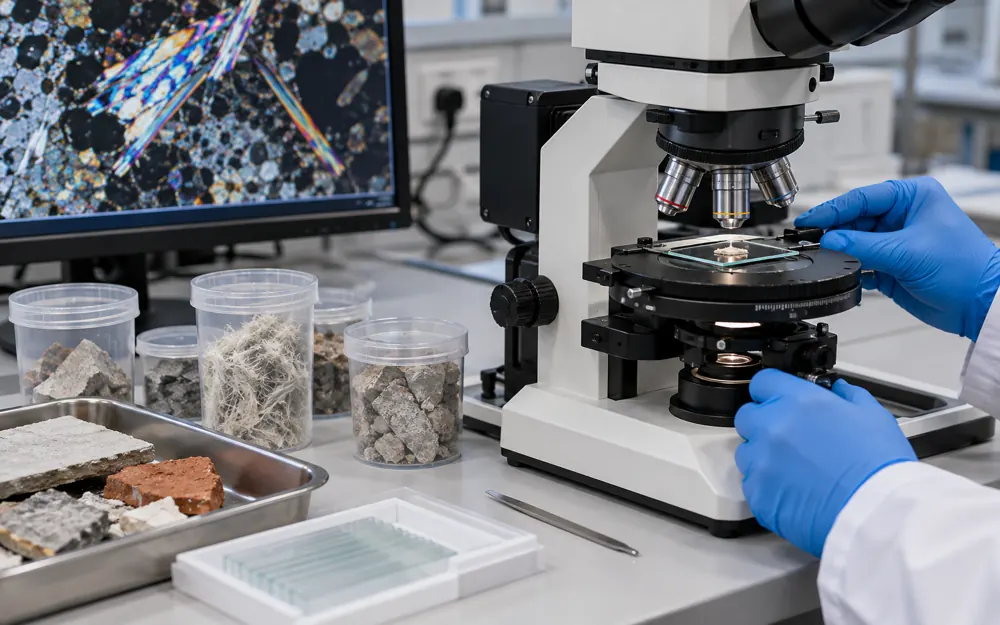
When Targeted Testing Is Useful
Asbestos testing can help answer a specific question about a suspect material before a maintenance or construction decision. Examples include an unfamiliar floor covering, a board exposed during inspection or material not described in an existing register. Looking at a photograph cannot establish whether a material contains asbestos.
A competent person should assess the location and the sampling approach before disturbing anything. A sample result relates to the submitted material and the location it represents. It does not establish that an entire building, ceiling system or floor is free from asbestos.
Sampling And Analysis Are Different Tasks
The site visit identifies a suitable sampling location, considers safe access and records what was sampled. Laboratory analysis then examines the submitted material using appropriate methods. Both parts need traceable references so a facilities manager can connect a certificate to the correct item on site.
HSE publication HSG248, Asbestos: The Analysts’ Guide, covers sampling and analysis alongside air monitoring and clearance procedures. Ask for a UKAS-accredited laboratory with the relevant bulk identification scope. Laboratory accreditation should not be confused with accreditation for surveying, air testing or every service offered by a contractor.
A Practical Testing Sequence
Begin by explaining why the material needs testing and what work is proposed. Send an existing survey reference if one is available, together with a location description. Photographs can help scope the visit, but they cannot replace sampling or establish whether the material is safe to disturb.
At the premises, the sampling approach should take account of material condition, nearby occupants and access hazards. The competent sampler should avoid unnecessary disturbance and leave the sample location safe. Sampling is a specialist task rather than a request for your maintenance team to break off a piece.
The sample is labelled and linked to the site record before laboratory analysis. Results should identify whether asbestos was detected in that sample and, where relevant, the fibre type identified. Any ambiguous connection between a sample reference and the building location should be resolved before work is authorised.
Understanding A Positive Or Negative Result
A positive result means the sampled material needs to be considered in the asbestos risk assessment. A positive sample at your Leicester premises does not by itself establish that removal is urgent or necessary. Condition, likelihood of disturbance and the planned work help determine the appropriate next action.
A result reporting no asbestos detected is specific to the sample analysed. Different layers, replacement panels or visibly different materials may need their own assessment. Ask the surveyor whether the sampling strategy adequately represents the materials affected by your proposed task.
Record the result in the building information used to brief contractors. Where a test exposes gaps in the register, a wider management or refurbishment survey may be appropriate. Testing should reduce uncertainty about a defined material rather than create false confidence about uninspected spaces.
What Affects Testing Cost
The number and variety of materials, site access, sampling complexity and laboratory arrangements influence testing cost. A single accessible material question differs from multiple locations across an operational factory. Tell us whether the work is part of a wider survey or a separate targeted visit.
Ask the quotation to distinguish site sampling from laboratory analysis and reporting. If you need an answer for a construction deadline, discuss the required timing before booking. Do not assume an advertised laboratory turnaround includes attendance, access arrangements and the time needed to interpret the result.
If A Material Has Already Been Disturbed
Stop the task and keep people away from the affected area if suspect material has been damaged. Avoid sweeping, using an ordinary vacuum cleaner or moving debris through occupied spaces. Inform the person responsible for the premises and obtain competent asbestos advice about assessment and next steps.
Testing may be one part of that response, but a sample alone does not assess the extent of contamination. The specialist may recommend an inspection, controlled cleaning or appropriate air monitoring depending on the circumstances. Use the enquiry form to describe the incident without attempting further disturbance to obtain a sample.
Asbestos Testing FAQs
Can A Photo Of Material At My Leicester Premises Confirm Asbestos?
Asbestos cannot be confirmed from a photograph because different materials can look alike and fibres are not reliably visible. Photographs can help a competent person understand the location and plan an inspection. Laboratory analysis of a representative sample is needed to confirm whether the sampled material contains asbestos, with safe sampling arranged first.
Does One Asbestos-Free Sample Cover Every Room At My Leicester Site?
A negative asbestos sample does not clear the whole building or automatically cover every similar-looking material. The result applies to the material submitted for analysis. A competent surveyor should consider variation, layers and the work area before deciding whether more samples or a wider asbestos survey are needed for your project.
Further guidance: HSE asbestos guidance.