Define The Air Monitoring Question At Your Leicester Site
Asbestos air testing measures airborne fibre concentrations under the conditions of the sampling exercise. The reason for testing determines where, when and how the monitoring is carried out. A general request to test the air is not enough to define a useful analytical brief.
Commercial buyers may need background monitoring, checks connected to removal controls, reassurance monitoring or clearance work. These purposes are different and should not be treated as interchangeable. Explain what happened, what work is underway and what decision the result needs to support.
Air Monitoring And Material Identification
An air test is not a replacement for identifying suspect building materials. Bulk sample analysis investigates whether a specific material contains asbestos. Air sampling addresses airborne fibres during a defined period and cannot prove the absence of asbestos-containing materials behind walls or above ceilings.
Routine fibre counting also has method-specific limits on identifying the origin of fibres. HSE publication HSG248 explains analytical approaches and reporting. The analyst should select and explain an appropriate method for the question rather than letting a headline result carry more meaning than the method supports.
Specifying The Analytical Visit
Give the analyst your Leicester site address, describe how the premises are used and explain why air monitoring is needed. Provide survey information, removal details and any incident description that may affect the sampling strategy. The analyst needs to know whether the premises are occupied and what conditions are expected during the visit.
Agree the sampling locations and purpose with a suitably competent analytical organisation. Check the relevant UKAS accreditation scope for air monitoring and clearance activities. Do not assume a firm accredited for bulk laboratory analysis is also accredited for every on-site analytical service.
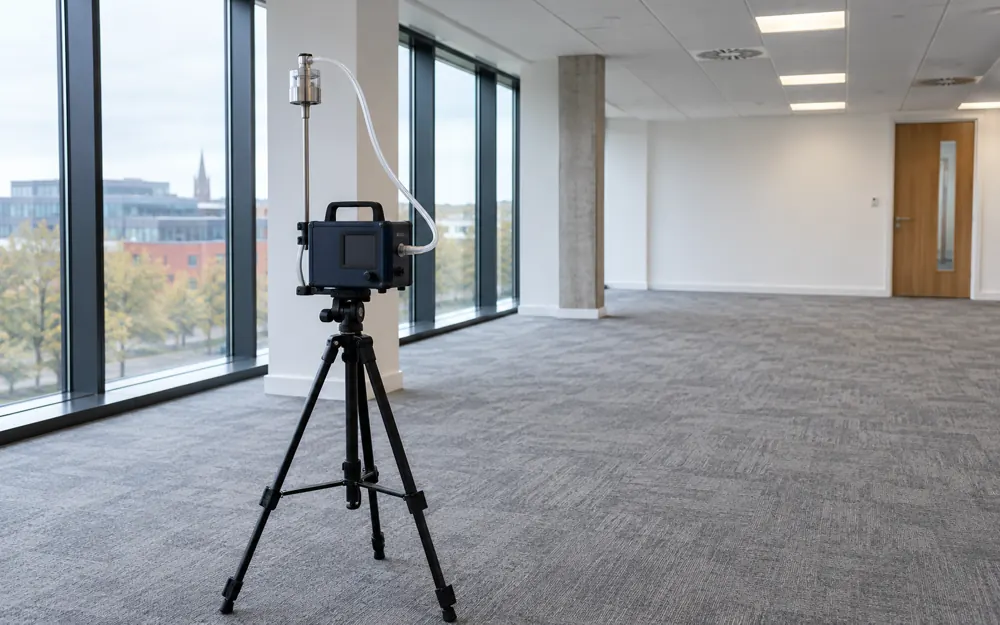
During attendance, calibrated equipment and controlled sampling arrangements support traceable results. The report should identify locations, timing, sampling conditions, method and results. If a result requires further action or interpretation, the responsible person should discuss that directly with the analyst before releasing work areas.
Four-Stage Clearance After Removal
Four-stage clearance is a structured assessment used in relevant licensed asbestos removal work. It includes checks of the work area and cleanliness as well as clearance air monitoring and a final assessment following enclosure removal. It is more than taking an air sample at the end of a job.
The independent analytical organisation needs sufficient information about the removal scope and enclosure. Plan access and analyst attendance alongside the removal programme rather than trying to add clearance at the last moment. Where the assessment is satisfactory, the appropriate certificate of reoccupation records the clearance outcome.
If a stage fails, further cleaning or corrective work may be necessary before reassessment. Programme decisions should allow for this possibility without pressuring the analyst to pass an area. Keep analytical records linked to the specific removal zone and the original scope of work.
Pricing Air Monitoring At Your Leicester Premises
The purpose of monitoring, number of sampling positions and time required influence cost. Repeat attendance, travel between separate work zones and coordination with removal stages can also affect a quotation. Clearance work should be quoted against the actual enclosure and removal details rather than a generic room count.
Ask what happens if the work area is not ready when the analyst arrives. Clarify whether additional visits or repeat tests are included and how they are charged. Confirm which report or certificate you will receive and how it relates to the decision to reoccupy the area.
Reassurance After An Incident
If suspect material has been disturbed, stop the activity and restrict access while competent advice is obtained. Air monitoring may be useful, but it should follow an assessment of the incident and any necessary controls. A reassuring result from one sampling period cannot erase material contamination elsewhere.
Describe the disturbance, location and occupancy in your enquiry. Do not restart work solely because someone suggests a quick air sample. The response may need material testing, inspection, controlled cleaning or a different analytical approach before normal use of the affected area can resume.
Air Testing & Clearance FAQs
Is Air Testing The Same As Four-Stage Clearance?
Air testing is one analytical activity and is not the same as the complete four-stage clearance process. Relevant licensed removal work needs a structured assessment that includes inspection and cleanliness checks alongside air monitoring. Ask the analytical organisation to explain the required process and the certificate that will record a satisfactory result.
Can An Air Test Prove There Is No Asbestos?
An asbestos air test cannot prove that a building contains no asbestos materials. It records airborne fibre conditions during the sampling exercise, subject to the method used. Concealed or intact materials can remain present without being identified by that test, so material surveys and management information are still needed for future work.
Further guidance: HSE asbestos guidance.